

SNES HyperZone
1 OF 1 · NO RESTOCK
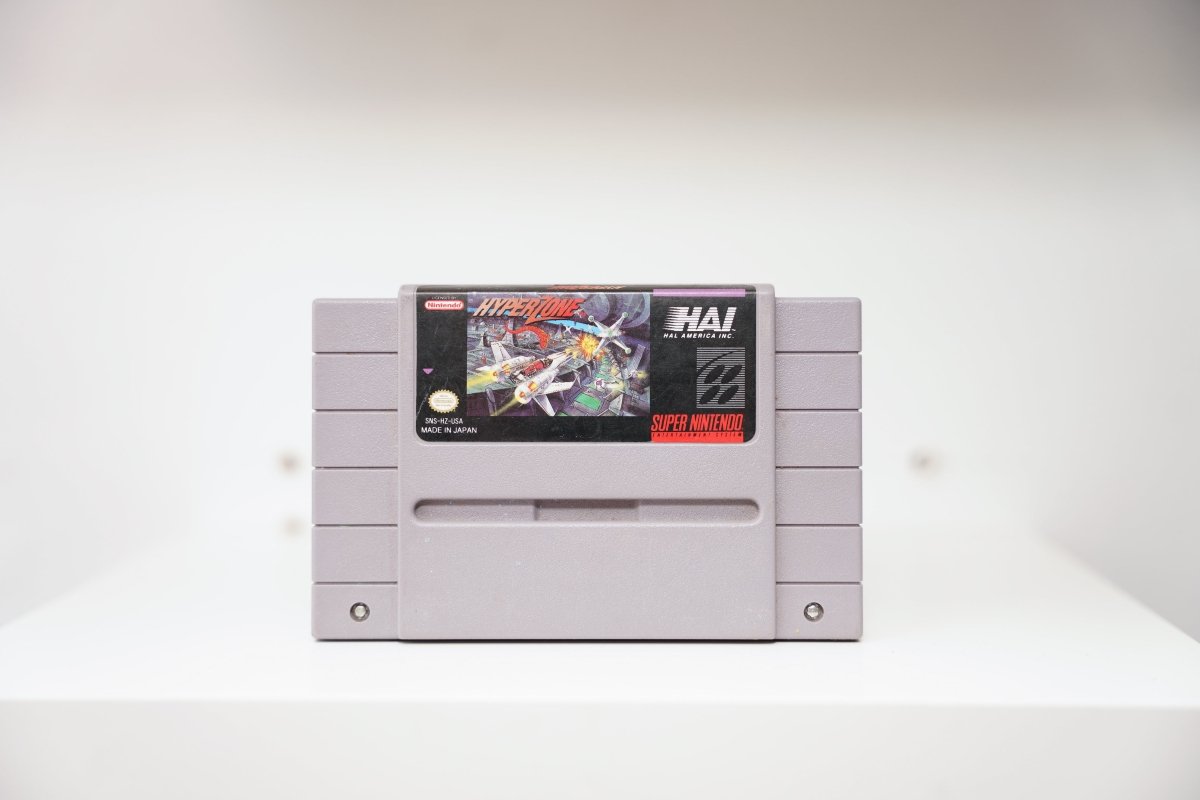
HyperZone is a 1991 SNES launch-window rail shooter developed by HAL Laboratory and published by Nintendo, built from the ground up as a hardware demonstration for the Super Nintendo's Mode 7 chip. Before a single third-party developer had shipped a Mode 7 title, HAL was using the console's native scaling and rotation to pull the play field toward the player at full clip, proving what the new architecture could do at a price point no arcade board could match at the time.
HAL Laboratory in 1991 was not a peripheral studio. This was the team that had already shipped Kirby's Dream Land concepts in prototype and would go on to build the Kirby franchise, the EarthBound sequels, and eventually the entire Smash Bros. engine. HyperZone was their SNES debut, and they treated it as a technical thesis. Mode 7 had been shown in Nintendo's own F-Zero, released at SNES launch in August 1991 in North America, where it drove the road surface beneath a simulated overhead camera. HyperZone flipped the application: instead of simulated ground, Mode 7 is pulling the enemy field and the play corridor directly at you from a behind-craft perspective, layering scaling objects at multiple depth planes simultaneously. The result is one of the faster-moving, more disorienting games on the system, designed to stress the hardware and the player in equal measure. It released the same launch season as F-Zero and Super Mario World, which means it spent its commercial life in an almost impossible shadow, underselling its engineering quality for thirty-plus years.
Mode 7 turned into the entire gameplay loop, a tech demo stretched into a full release.
This copy is cart only, pre-owned, consistent with the standard configuration for a title that rarely surfaced with the original box and manual intact. The label should show clean color with minimal scuffing, as HyperZone labels were printed on thicker stock than many HAL releases from the period. The cartridge shell itself runs standard gray SNES form factor with the Nintendo molding on both sides. Before it goes in the reader, turn the cart and check the edge connector pins, they should show even oxidation across all contacts with no bent or missing pins on either row.
OWNER VERIFY: Confirm production year as 1991 against the Nintendo copyright text printed on the cartridge label back.

Mode 7 turned into the entire gameplay loop, a tech demo stretched into a full release.
The Nintendo Archive
This is part of Nintendo's 90s run, the era that built the shop's back wall. Nintendo shipped cartridges, plush, promotional oddities, and packaging that most buyers threw out on the way to the game. What survived, mostly by accident, ends up here. Every piece is cleaned, photographed, and listed one at a time. Nothing on the archive shelf is a duplicate.
INSPECTED IN STORE / 707 E FREMONT, LAS VEGAS
Inspected in Las Vegas on October 2026. Each piece is a single unit, sold as inspected.
KEEP IT CLASSIC
This snes hyperzone originates from the 90s era[01], represents Nintendo[02]'s output, . Each piece in the shop is a single unit, inspected by hand in Las Vegas before listing. The data manifest to the right records the fields on file for this lot; where a field is empty it has been omitted rather than guessed.
INSPECTED IN STORE / 707 E FREMONT, LAS VEGAS
- VENDOR
- Nintendo
- ERA
- 90s
A hidden gem for WrestleMania fans 🥳 📍 keepitclassiclv containerpark dtlv
14 days from delivery. Buyer pays return shipping. In-store purchases are exchange or credit only.
Every piece in the shop is a single unit. Once it is gone, it is gone.
707 E Fremont Street, Suite 1170, ground floor, east side of Downtown Container Park.


