

Field Guide
The Wrestling Jersey Collector Guide. NWO, DX, Attitude Era, And The Crossover Cuts.
Intro
Wrestling jerseys are not the same thing as wrestling shirts, and the collectors who chase them know it. A wrestling tee is the dense center of the merch market. A wrestling jersey is the rarer cousin, a crossover cut where the licensors borrowed the silhouette of football or hockey or basketball and printed a faction logo, a wrestler's name, or a championship moment onto it. Most wrestling fans have a stack of tees. Almost none have a real Chalkline NWO Wolfpac hockey jersey from 1998 in their hand. That gap is the whole reason this guide exists.
This page is the collector's view of the wrestling jersey segment. We separate it from the tee market because the dating signals, the manufacturer mix, the survival rates, and the authentication moves are different. We also separate it from the broader vintage jersey market because wrestling-branded jerseys live in a licensing universe of their own, with Chalkline, Logo Athletic, and a small constellation of in-house runs producing limited drops that did not always reach mass retail.
What this guide covers, in order. What actually counts as a wrestling jersey, in the way collectors use the term. The faction-led runs that drove the segment, NWO Wolfpac and Degeneration X and the WCW NBA crossover cuts. Wrestler-branded pieces from Hulk Hogan and Stone Cold and the Hardy Boyz. The Attitude Era as the peak of wrestling-as-jersey crossover, and why. Manufacturer signals to read at the neck. Authentic versus replica versus the bootleg market that lives near the convention floor. Sizing quirks. A collector-tier framework. Then a section on the surrounding wrestling cohort that we hold on the floor at 707 East Fremont, because the tees and posters and figures around the jersey market are the documentary record that lets you place a jersey in its era. FAQ at the bottom.
For era context on wrestling at large, the parent reference is the vintage wrestling archive, which moves through Hulkamania, the New Generation, Attitude, Ruthless Aggression, and the WCW and ECW parallel tracks. For construction-tier authentication that crosses every sport, the sibling is the jersey authentication guide. This page is the wrestling-specific lane between those two.
What counts as a wrestling jersey
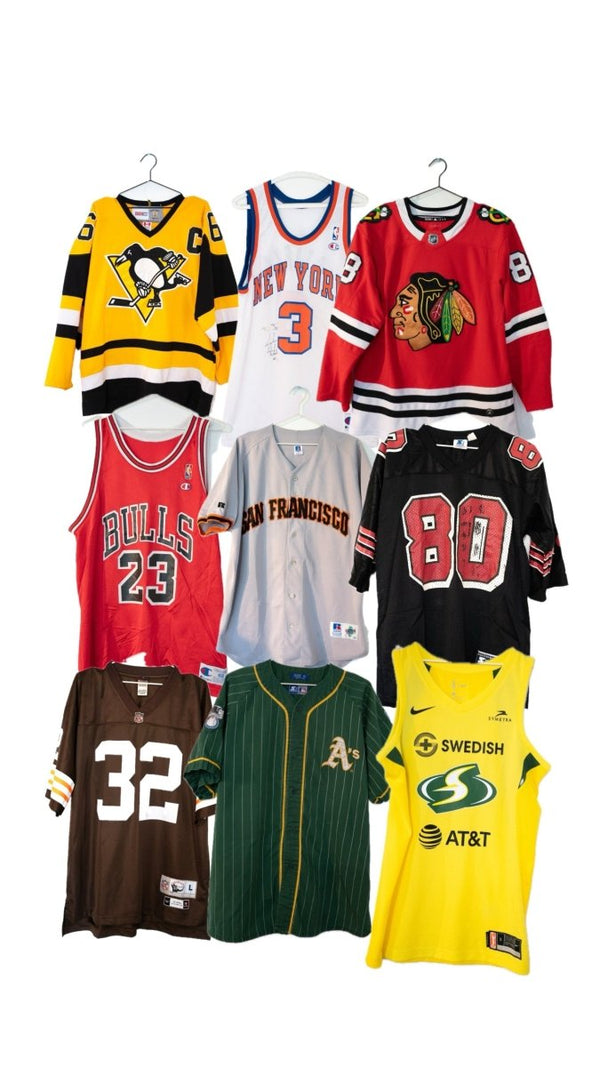
Inside the collector market, "wrestling jersey" is a specific phrase. It does not mean a wrestling tee. It does not mean a singlet, which is the in-ring outfit. It means a licensed garment cut in the silhouette of a football jersey, a hockey jersey, a basketball jersey, or a baseball jersey, carrying wrestling-licensed graphics. The cut is borrowed from another sport. The branding is wrestling.
Three sub-categories sit inside that frame.
Faction jerseys. NWO Wolfpac hockey jerseys, NWO black-and-white basketball jerseys, Degeneration X football jerseys, the WCW Monday Nitro pullovers. These are the densest run inside the segment. The faction is the brand, the wrestler may or may not be named on the back, and the licensee is usually Chalkline or Logo Athletic.
Wrestler-branded jerseys. Hulk Hogan Hulkamania football jerseys with a 1 on the back. Stone Cold 3:16 custom cuts. Hardy Boyz hockey-style jerseys from the late 90s tag-team run. These named the wrestler directly and tracked the active push window.
Event and championship crossover jerseys. WrestleMania commemorative cuts. The 1998 WCW Bash at the Beach NBA crossover apparel that included the DDP and Karl Malone versus Hollywood Hogan and Dennis Rodman match. These are limited to a single show or a single moment.
A WWF or WCW or ECW tee is not a wrestling jersey, even if the print is great. A singlet is in-ring gear, not a collector jersey. A wrestling-themed Halloween costume is not a jersey. The collector frame is narrow on purpose, and prices reflect the narrowness.
Faction jerseys. The NWO Wolfpac and DX runs.
The New World Order angle in WCW from 1996 forward produced more wrestling-jersey crossover product than any other faction in the era. The Wolfpac splinter, with the red-and-black colorway, was particularly well-suited to hockey-jersey treatment. Kevin Nash, Sting in his Wolfpac alignment, Lex Luger, and Konnan all carried Wolfpac-branded apparel through 1998. Chalkline ran the official Wolfpac satin and pullover line. Logo Athletic ran a parallel cut on heavier knit.
The Degeneration X jersey treatment in WWF ran shorter but ran famous. The DX football-style jersey from 1998 with the green and black colorway is a recognizable piece, often paired with the "Are You Ready" graphic that pulled a stadium-sized response on Monday Night Raw. The Hyland licensee stamp dates these cleanly to the Attitude Era window.
Authentication signals on faction jerseys are tag-led. The Chalkline neck tag iteration matters. Mid-90s Chalkline read in block with a sub-tag carrying the licensed faction, the era of the run, and a country-of-origin code. Late-90s Chalkline added a flag tag with year integration. Logo Athletic carries its own neck-tag cataloging that does not generalize from Chalkline. A jersey claiming to be 1998 NWO Wolfpac with a tag that does not match the Chalkline or Logo Athletic windows of that year is post-era.
Wrestler-branded jerseys. Hulkamania, Stone Cold, and the named pieces.
Hulkamania-branded jerseys built on the football and basketball cut in the late 80s and early 90s. The Hulk Hogan number-1 football-style jersey, with the Hulkamania script across the chest, is the foundation piece of the segment. Tags from this run carry Titan Sports, Inc. licensing, with Wild Oats or in-house licensee printing on the rear neck or hem. Single stitch construction is normal in the early window.
Stone Cold Steve Austin's branded apparel ran predominantly on tees, but a small run of Stone Cold cut-sleeve jerseys and faux-football jersey crossovers exists from the 1998 to 2001 window. These are scarce. The licensee shifts from Titan Sports to WWFE during 1999, the same window the corporate name changes.
The Hardy Boyz hockey-style jerseys from the late 90s tag-team run are a smaller cohort but a recognizable one. The graphic is the Hardy Boyz logo on a hockey-jersey silhouette. Production was limited.
Wrestler-branded jersey runs do not always survive in the active inventory market. We pull tees from these wrestlers regularly. We have not pulled a wrestler-branded crossover jersey in the recent inventory window.
The WCW NBA crossover. Bash at the Beach 1998.
This is the cleanest example of how wrestling-jersey crossover apparel happens. Bash at the Beach 1998 staged a tag match between Diamond Dallas Page partnered with NBA player Karl Malone, against Hollywood Hogan partnered with Dennis Rodman. The match was a two-sport crossover, and the merchandise was a two-sport crossover. WCW released a commemorative shirt for the bout that carried both the wrestler likenesses and the NBA-player likenesses. We have moved that piece through the floor more than once. The product is at /products/1998-wcw-nwo-ddp-and-karl-malone-vs-hollywood-hogan-and-dennis-rodman-shirt.
The Bash at the Beach 1998 commemorative is not a jersey in the strict cut sense. It is the bridge that signals the broader commercial logic: WCW, more than WWF in the same window, leaned into the basketball-jersey aesthetic for its merch, in part because Hogan and Rodman as a pairing made it natural. Some of the heavier WCW pullovers from the same window read as basketball-jersey crossover even when the cut is not strictly that. Tour Champ and OmniGraphics are the in-house and licensed manufacturers to know.
Attitude Era as the peak crossover window
The Attitude Era from 1997 to 2002 is the period when wrestling jerseys reached their highest production rate. The reasons are commercial. WWF was running its largest mainstream cultural footprint in company history, the Monday Night Wars with WCW were producing licensed crossover output on both sides, and the apparel market itself was at the height of the satin-and-jersey aesthetic in mainstream streetwear. Chalkline, Logo Athletic, and the in-house licensors scaled their wrestling-branded jersey output through this window, then contracted sharply as the apparel market shifted in the early 2000s.
If you collect wrestling jerseys, the Attitude Era window is where the segment is densest. NWO Wolfpac, NWO black-and-white, Degeneration X, Hardy Boyz, Stone Cold, and the WCW commemorative pieces all sit inside this five-year band. The jersey segment effectively closes around 2002 and 2003, with smaller runs continuing through Mitchell and Ness throwback collaborations in later years.
Manufacturer signals to read at the neck
Wrestling jerseys carry the same authentication discipline as the broader vintage jersey market, with manufacturer-specific notes that are wrestling-particular.
Chalkline. Founded in Birmingham, Alabama. Chalkline ran the satin and nylon pullover line that dominates the wrestling-jersey segment in the mid-to-late 90s. Neck tags through this window carry Chalkline in block with a sport or faction sub-tag, country-of-origin sub-tag, and a year-integrated flag tag on later runs. Body cloth is heavyweight nylon-satin with a particular dry hand. Reproduction Chalkline pieces are widespread on the secondary market and run lighter shell weight, lighter snaps where snaps are present, and a chest emblem that is heat-applied or sublimated rather than embroidered.
Logo Athletic. Indianapolis-based licensee that ran across NFL, MLB, and wrestling crossover. Logo Athletic neck tags carry a flag-and-block design with year coding on late-90s runs. Construction is heavier on the football-jersey cuts than on the lighter pullovers.
Hyland. A wrestling-specific licensee that ran heavily through the Attitude Era. Hyland tags appear on Degeneration X, Stone Cold, and other WWF runs. The Hyland licensee stamp dates the production cleanly inside the late 90s.
WCW Inc and Tour Champ. Tour Champ ran a substantial portion of the WCW apparel licensing through the Nitro era. Neck-tag iteration follows the broader Tour Champ catalog. WCW Inc itself ran in-house production for some of the heavier pieces.
Titan Sports and WWFE and WWE. The WWF corporate naming chain runs Titan Sports, Inc. through 1999, World Wrestling Federation Entertainment, Inc. from 1999 through 2002, then WWE, Inc. from 2002 forward. The licensee stamp inside the wrestling jersey will date the production window directly.
The fastest authentication move on a wrestling jersey is to read the manufacturer tag against the era. If a jersey claims to be 1998 NWO Wolfpac and the tag is post-2003 reproduction Chalkline, the jersey is not authentic. Tag iterations beat graphic accuracy every time, because graphics are easy to clone and tags are not.
Authentic versus replica versus the bootleg market
The wrestling jersey market lives with three production tiers and one shadow market.
Authentic licensee runs. Chalkline, Logo Athletic, Hyland, Tour Champ, and the in-house WWF and WCW production through the era. These are the original-run pieces. Heaviest body cloth, embroidered or stitched-twill emblems, era-correct tag iteration, and country-of-origin codes that match the production window.
Replica licensee runs. A lighter-tier cut that licensees sometimes ran alongside the authentic pieces. Same brand, same era, same era-correct tags, but lighter body and often screen-printed graphics in place of embroidery. These are real licensed product, just at a lower production tier.
Modern reproduction and reissue. Mitchell and Ness throwback collaborations from the 2010s onward produced legitimate licensed reproductions of certain wrestling jerseys. These are not bootlegs. They are licensed reproductions. The neck tag will say Mitchell & Ness Nostalgia Co. with a year-coded sub-tag identifying the season the jersey commemorates, not the year of original production.
Convention bootleg. This is the shadow market. Bootleg wrestling jerseys produced in unlicensed runs, often sold at WrestleCon and similar conventions during the major-show weekends. Tag iteration is wrong, body cloth is light, graphics are screen-printed flat, and the licensee stamp is either missing, faked, or printed where it should be sewn. The convention bootleg market is the largest source of fakes in the wrestling jersey segment.
The defense across all three real tiers and the shadow market is the same: read the tag iteration first, then the body cloth weight, then the graphic construction, then cross-check the production window.
Sizing quirks
Wrestling jerseys frequently run XL, XXL, and XXXL as part of the era's silhouette, particularly through the Attitude Era. The crossover audience for wrestling apparel in the late 90s skewed heavily toward the oversized-streetwear silhouette. A wrestling jersey from this period in size Medium is a smaller fraction of the run than the larger sizes. This affects survival rates: smaller sizes often appear less in the secondary market simply because fewer were made and more wore through.
A second sizing note. Wrestling-branded football jerseys often follow football-jersey sizing, which runs longer in the body than basketball-jersey sizing. A wrestling football jersey marked Large will frequently fit a body the way a Medium tee fits. Hockey-jersey-cut wrestling pieces follow hockey-jersey sizing, which is closer to streetwear sizing. Read the cut and the sport before you read the size tag.
A collector-tier framework
For a collector building a wrestling jersey set, the tier framework that organizes the segment is faction first, wrestler second, event third.
Tier 1, faction-defining. NWO Wolfpac (Chalkline, Logo Athletic), NWO black-and-white (Chalkline), Degeneration X (Hyland and in-house). These are the spine of the segment.
Tier 2, wrestler-branded. Hulk Hogan Hulkamania jerseys, Stone Cold custom cuts, Hardy Boyz hockey-style jerseys. Smaller cohort, period-defining names.
Tier 3, event and crossover. Bash at the Beach 1998 commemorative pieces, WrestleMania crossover apparel, WCW commemorative pullovers from the Nitro-era pay-per-view circuit.
A complete collection within the wrestling jersey segment is a stretch project. Authentic pieces in good condition surface on the secondary market in single units and small batches. The collector who treats the segment as a multi-year build, with patience between acquisitions, fares better than the collector who pushes for completion in a season.
From the Vault. The wrestling cohort around the jersey market.
We hold a deep wrestling cohort at 707 East Fremont. The jersey segment specifically is thinner in our active and archived inventory than the tee segment, by an order of magnitude. The pieces we move regularly that document the era around the jersey market include:
-
1993 WWF Titan Sports The Undertaker Wild Oats Shirt. Textbook New Generation tag-and-licensee combination.
/products/1993-wwf-titan-sports-the-undertaker-wild-oats-shirt -
1998 WCW NWO DDP and Karl Malone vs Hollywood Hogan and Dennis Rodman Shirt. The Bash at the Beach 1998 commemorative, the bridge piece between wrestling apparel and the NBA crossover market.
/products/1998-wcw-nwo-ddp-and-karl-malone-vs-hollywood-hogan-and-dennis-rodman-shirt -
1998 WWF Stone Cold Steve Austin 3:16 Stunner Shirt. Attitude Era foundation.
/products/1998-wwf-stone-cold-steve-austin-3-16-stunner-shirt-sz-xl -
1999 WWF Stone Cold Steve Austin Cut Sleeve Shirt. WWFE-era licensee transition window.
/products/1999-wwf-stone-cold-steve-austin-cut-sleeve-shirt -
1997 WWF Survivor Series Montreal ScrewJob Shirt. The single most documented backstage moment in wrestling history, on a commemorative print.
/products/1997-wwf-survivor-series-montreal-screwjob-shirt -
1999 WCW Bill Goldberg You're Next Shirt. Goldberg streak window.
/products/1999-wcw-bill-goldberg-you-re-next-shirt -
1999 WWF RAW IS JERICHO Shirt. Y2J debut shirt, the launch of the running "Raw Is" merch format.
/products/1999-wwf-raw-is-jericho-shirt-medium -
1999 WCW Slamboree PPV Security Shirt. Production-crew Slamboree apparel, an under-collected sub-segment.
/products/1999-wcw-slamboree-ppv-security-shirt-size-xxl
These are tees and one production-crew shirt, not jerseys. They sit inside our active and archive inventory as the documentary frame around the jersey segment. When a wrestling jersey crosses our floor, it is treated as a tier-1 archive piece on its own, photographed and graded against the manufacturer and era references on the counter.
If you have wrestling jerseys you are looking to consign or sell, the address is info@keepitclassiclv.com or come by 707 East Fremont Street, Suite 1170 on the ground floor of Container Park. We pay fairly. We grade in hand.
How this page fits the wrestling cluster
This guide is the wrestling-specific lane inside a cluster that also contains the vintage wrestling archive for era and decade context, and the jersey authentication guide for the construction-tier discipline that crosses every sport. If you arrived here looking for general jersey authentication, the sibling guide is the right next read. If you arrived looking for wrestling history at large, the parent archive is the right next read. This page is the narrow segment between those two: jerseys, but specifically the wrestling-branded ones.
Active wrestling inventory lives at /collections/wrestling. The Friday Drop posts the highlights when wrestling pieces come through, which is most weeks.
FAQ
Q. What is the difference between a wrestling jersey and a wrestling tee? A. A wrestling jersey is cut in the silhouette of a football, hockey, basketball, or baseball jersey, with wrestling-licensed graphics. A wrestling tee is a t-shirt. Collectors use the words separately because the dating signals, the manufacturer mix, and the survival rates are different. Most wrestling fans have a stack of tees. Far fewer have authentic wrestling jerseys.
Q. Are NWO Wolfpac hockey jerseys real or were they replicas only? A. Real licensed runs exist. Chalkline produced the official Wolfpac satin and pullover line in 1998 and 1999. Logo Athletic ran a parallel cut on heavier knit. Both are authentic licensee production. The reproduction market on Wolfpac jerseys is also wide, so authentication discipline matters. Read the Chalkline or Logo Athletic neck tag iteration against the late-90s production window.
Q. Did Hulk Hogan have an actual jersey, or just t-shirts? A. Both. Hulkamania-branded football-style jerseys with a 1 on the back exist from the late 80s and early 90s window, with Titan Sports, Inc. licensing. The tee market for Hogan is much larger than the jersey market.
Q. What does Chalkline mean as a brand? A. Chalkline is a Birmingham, Alabama-based apparel licensee that ran the satin and nylon pullover line through the 90s, including a heavy run of wrestling-branded jerseys and pullovers. Chalkline-tagged wrestling pieces from the mid-to-late 90s are among the most collectible jerseys in the segment.
Q. Is the WCW Bash at the Beach 1998 shirt a jersey? A. Not in the strict cut sense. It is a tee commemorating the wrestler-and-NBA-player tag match between Diamond Dallas Page partnered with Karl Malone against Hollywood Hogan partnered with Dennis Rodman. We include it in the wrestling-jersey conversation because it is the cleanest documented bridge between the wrestling apparel market and the NBA crossover apparel market in the era.
Q. How do I tell a real wrestling jersey from a convention bootleg? A. Tag first. Bootleg wrestling jerseys from the convention market typically have wrong tag iteration, missing or faked licensee stamps, and screen-printed graphics where embroidery or stitched twill belongs. Body cloth is lighter than authentic-era. Cross-check the manufacturer tag against the production window for the year claimed.
Q. Are there wrestling jerseys from ECW? A. Very few. ECW's merch character was lower-print-run, heavier on hardcore-poster-style tees, and the company did not run a substantial jersey program. Authentic ECW jerseys are rare on the secondary market.
Q. Do you have wrestling jerseys at the shop right now? A. The wrestling tee inventory is dense most weeks. The wrestling jersey segment is thinner. When a wrestling jersey crosses the floor it is treated as a tier-1 archive piece. The active wrestling collection is at /collections/wrestling. The Friday Drop posts the highlights as they come.
Q. What size do most wrestling jerseys run? A. Larger. The Attitude Era silhouette skewed toward XL, XXL, and XXXL. Smaller sizes are a smaller fraction of the original run and survive less in the secondary market.
Q. Do you ship internationally? A. Yes. Customs and duties are the buyer's responsibility. Shipping is calculated at checkout.