



VHS Distributor Eras: How to Identify and Authenticate Vintage VHS
Keep It Classic. Updated 2026-04-17.
Wrestling VHS from Coliseum Home Video carries a different catalog pattern than WWE Home Video re-releases. Disney clamshells land differently than Warner Home Video cardboard slipcovers. Blockbuster rental copies came with sticker residue that reveals the rental-era release window. The spine, the catalog number, the copyright block, and the tape-speed marker tell you what you are actually holding. This guide covers the distributor tells we use before we list a VHS on the floor.
The market problem
VHS is one of the easiest vintage categories to misrepresent by accident. The same title was released three or four times across a 20-year window, often with different distributors, different runtimes (theatrical cut vs. television cut), and different case styles. A 1989 Coliseum Home Video release of a WWF event is a different object than the 2003 WWE Home Video re-release of the same event with the F-to-E rebrand, new music due to the 2002 music-rights licensing shift, and different packaging. The tape itself often looks identical on the shell. The spine and the copyright block are where the truth lives.
On top of that, bootleg VHS is everywhere, especially on wrestling, anime, and rental-era horror. Bootlegs copy the art but miss the distributor details. If you know where to look, they flag themselves in under a minute.
Distributor overview (wrestling focus)
- Coliseum Home Video (1985-2001). The WWF's in-house home-video label, distributed through Coliseum Video. Catalog numbers follow a "WF###" pattern on most releases (WF001 through roughly WF150+ across the run). Clamshell cases dominate the 1985-1995 window. Cardboard slipcovers appear later. Copyright block on the back cover credits "TitanSports, Inc." or "World Wrestling Federation Entertainment, Inc." depending on the year. Three-letter F-is-silent era terminology applies to any Coliseum-pressed tape.
- WWE Home Video (2002-present). After the 2002 WWF-to-WWE rebrand (lost the trademark dispute with the World Wildlife Fund), WWE Home Video replaced the Coliseum line. Cases shift to the standard black cardboard slipcover. Catalog numbers shift to a WE-prefix or a new internal system. Music on event re-releases is often replaced due to the 2002 music licensing shift, which is a flag for collectors who want the original broadcast audio. These are modern re-pressings of older footage, not original-era releases.
- WCW Home Video (1988-2001). Released through Turner Home Entertainment. Cardboard slipcover from the start. Copyright on the back reads "Turner Home Entertainment" or "World Championship Wrestling, Inc." Catalog numbers follow Turner's internal pattern, usually a 6-digit code.
- ECW Home Video. Pre-2001 ECW releases came through RF Video and Pioneer Home Video in small pressings. Post-WWE acquisition ECW re-releases fall under WWE Home Video.
Distributor overview (mainstream film)
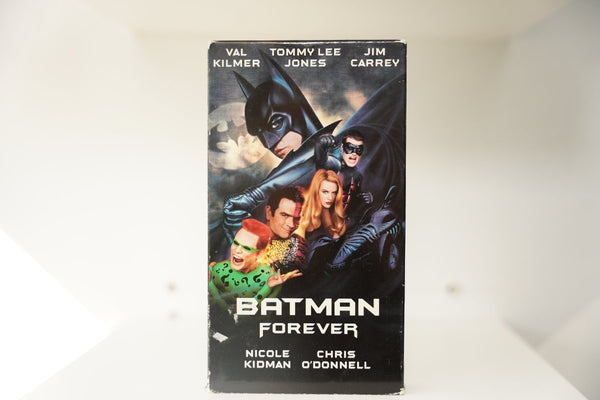
- Warner Home Video. Cardboard slipcover across most of the 80s-90s run. Catalog number on the spine follows a 5-digit pattern. Batman (1989) on Warner Home Video is a high-volume pressing that shows up constantly in thrift inventory.
- Walt Disney Home Video / Walt Disney Classics / Masterpiece Collection. Clamshell through most of the Classics era (1984-1994), slipcover post-Masterpiece Collection. The black diamond-logo Walt Disney Classics releases and the "Not for Sale or Rental" flag on early Masterpiece tapes drive collector interest.
- MCA / Universal Home Video. Clamshell through the 80s, transitioning to slipcover. E.T. The Extra-Terrestrial has a famously layered release history with different pressings carrying different spine colors and holograms.
- Paramount Home Video. Mix of clamshell and slipcover. Blue-spine Paramount tapes are a collector category.
- Good Times Home Video / GoodTimes. Budget distributor. Often licensed older public-domain or low-rights titles. Lower production quality, thinner tape stock.
Six authentication checks
1. Clamshell vs cardboard slipcover
Clamshell is the hinged rigid plastic case that snaps shut. Dominant from the early-80s launch of VHS through roughly 1993-1995 for most major distributors. Disney held clamshell longer. Cardboard slipcover is the two-piece cardboard sleeve with a plastic inner sleeve that the tape slides into. Slipcover dominated from the mid-90s through the format's retail collapse around 2006. Case style is not a verdict by itself (distributors overlapped), but it narrows the release window to within a few years.
2. Spine catalog number
Almost every commercial VHS release carries a catalog number on the spine, usually at the bottom. Format varies by distributor. Coliseum uses WF-prefix. Warner uses a 5-digit code. Disney uses variable-length numeric codes. Cross-reference the catalog number against the release history for that title. Mismatched catalog numbers on identical-looking packaging is a bootleg tell.
3. Copyright block on the back cover
Read the fine print at the bottom of the back cover. It tells you the production company (TitanSports for WWF pre-2002, Turner for WCW, the film studio for mainstream releases), the distribution company (Coliseum, Warner, etc.), and the copyright year. The copyright year on the tape is usually the release year, which may be different from the original content year. A 1997 WWF event rereleased in 2003 carries a 2003 WWE Home Video copyright on the new pressing.
4. SP / SLP / EP tape-speed marker
Commercial retail VHS was almost universally recorded in SP (Standard Play, 2-hour tape on T-120 stock). SLP (Super Long Play, 6-hour on T-120) and EP (Extended Play, synonymous with SLP on most decks) were consumer recording modes. A retail release that says "Recorded in SLP" or "Recorded in EP" on the label is either a budget re-press (Good Times and similar distributors occasionally used SLP to fit more runtime on cheaper stock) or a bootleg dubbed off broadcast. Major-label original retail is SP.
5. Rental sticker remnants and the rental-era window
Blockbuster Video, Hollywood Video, and local rental shops bought their VHS through a different distribution tier (rental-window releases) from retail sell-through releases. Rental tapes are often labeled "For Rental Use Only, Not for Sale." Sticker residue on the spine and the top of the case, along with a barcode sticker on the clamshell face, indicates a former rental copy. These are legitimate releases, just a different pressing run and often an earlier window (6-8 months before retail sell-through in the pre-2000 era). They are commonly discounted at sale. That does not make them less authentic; it identifies the lineage.
6. Japanese NTSC vs US NTSC
Both Japan and the US use NTSC, but Japanese VHS releases carry different catalog, label, and packaging conventions. Japanese-release VHS often shows up in US vintage inventory via import. Tells: Japanese-language spine text, obi strip (wraparound paper band), catalog prefix specific to the Japanese distributor (VAP, Pony Canyon, Columbia, etc.). A Japanese NTSC tape plays on a US NTSC VCR. It is not a bootleg, it is an import.
Bootleg tells
- Hand-applied label art. Real retail VHS uses heat-transfer label printing directly on the shell. Bootlegs often stick paper labels on top of a blank shell. The label peels.
- Missing or generic catalog number. A retail spine always has a catalog number. Bootlegs either leave it off or invent one that does not cross-reference.
- SLP or EP tape-speed recording on a "retail" release. Big flag. Almost all commercial retail is SP.
- Fuzzy or pixelated cover art. Bootlegs photocopy the cover, losing resolution. Real retail covers are crisp offset print.
- No FBI warning, no distributor copyright. Every US retail VHS carries the FBI anti-piracy warning at the head of the tape and a distributor copyright on the back cover. Missing either is a bootleg tell.
Our method
Every VHS we list gets the same five-point check: case style for era placement, spine catalog number lookup, copyright block read, tape-speed confirmation (SP expected), and rental-history check for sticker residue. We photograph the spine and the back-cover copyright block on every wrestling and collector-tier listing so you can run the same check before you buy. For wrestling titles where the Coliseum Home Video vs WWE Home Video re-release distinction matters to collectors, we call it out in the listing body.
See the method on real pieces
Active VHS on the floor right now:
- WWF Chris Jericho Break the Walls Down VHS (Sealed). Sealed Coliseum-era three-letter WWF release. Spine catalog number visible in photo 2.
- Ready to Rumble VHS. 2000 Warner Home Video release, cardboard slipcover, WCW crossover film.
- Batman VHS. 1989 film, Warner Home Video pressing.
- The Terminator VHS. Hemdale/HBO Home Video era release.
- Indiana Jones and the Last Crusade VHS. Paramount Home Video, late-80s pressing.
Related
Browse the VHS Tapes collection or the Wrestling collection. Coming soon: Coliseum Home Video vs WWE Home Video re-release identification (deeper dive on the catalog-number, music-rights, and packaging shifts that separate the two).
FAQ
Is this VHS a bootleg?
Run the five checks: case style, spine catalog number, copyright block, tape-speed marker, and cover-art print quality. A bootleg will usually fail on catalog number or tape-speed. If it passes all five, it is a legitimate pressing.
What is the difference between Coliseum Home Video and WWE Home Video?
Coliseum Home Video was the WWF's in-house distributor from 1985 through the 2001-2002 rebrand. WWE Home Video replaced it in 2002 after the F-to-E trademark shift. WWE Home Video re-releases of pre-2002 events often have replaced music (due to the 2002 music-rights change) and updated packaging. Original-broadcast music survives on Coliseum pressings.
How do I tell the difference between SLP and SP on a VHS?
The tape speed is labeled on the packaging for commercial releases, usually on the back of the case in small print near the runtime. Almost all commercial retail VHS is SP. If it reads SLP or EP, it is either a budget distributor re-press or a bootleg recorded off broadcast.
Are Blockbuster rental VHS valuable?
Generally no more than retail copies of the same title, unless the title was rental-only (some films had rental-window-only releases before going to sell-through). The rental sticker residue is a historical marker, not a value multiplier on most titles.
What does the Coliseum Home Video WF catalog number tell me?
It identifies the specific release within Coliseum's catalog. WF001 is an earlier release than WF150. Cross-reference against WWF VHS-ography resources to date the exact pressing window and confirm the release is not a later re-pressing under the same catalog number.