

Field Guide
How To Identify Retro Video Games
How To Identify Retro Video Games
A field guide from a shop that hand-grades every cartridge.
Every cartridge that crosses our counter at 707 East Fremont gets the same routine. Out of the case. Under the loupe. Label inspected for print quality, registration, and aging pattern. Shell checked for screw style, mold seam, and weight. Battery saves verified on hardware where the title supports it. Box, manual, and inserts ranked against a known-good reference. Then a five-tier condition grade goes on the listing, and the macro photos go on the product page.
We are writing this guide because most online identification advice is recycled forum text from ten years back, and reproduction quality has moved faster than the advice has. The cartridges sitting in our vault span Super Nintendo, Nintendo 64, Game Boy Advance, and Sega Genesis, with a steady drip of NES, Game Boy, Saturn, and Dreamcast on the shelves behind them. What follows is what we actually look at, in the order we look at it, when a piece comes in for buy, trade, or grading.
This is the hub. SNES collectors who already know the label-revision rabbit hole can jump straight to our deeper sub-page on SNES cartridge label variants. Everything else is up here.
Region codes are the first thing we read
Before condition, before completeness, the region code on the back of the cartridge or the spine of the box tells us what hardware the title is supposed to play on. Plug the wrong region into the wrong console and the cart either refuses to boot, boots in the wrong frame rate, or boots at the wrong screen resolution.
The three region families collectors meet most often:
NTSC-U is North American. The format runs at roughly 60 Hz. SNES carts read SNS- product codes. N64 carts read NUS- codes followed by region letters that end in -USA. Game Boy Advance carts read AGB- codes ending in -USA. Genesis carts are stamped with a five or six character product code on the back label.
NTSC-J is Japanese domestic. SNES (called Super Famicom in Japan) carts have a different physical shape, smaller, two-tone, top-locking notches absent. N64 Japanese carts are physically the same but ship with -JPN suffixes and refuse to boot on a stock US N64 without a region adapter or modification. GBA shows -JPN. Japanese Genesis is called Mega Drive and ships in a different case shape entirely.
PAL is European and Australian. The format runs at 50 Hz, so titles often play 17 percent slower than their NTSC-U counterparts unless the developer compensated. PAL carts on every system carry -EUR, -UKV, -AUS, -NOE, -FAH, or similar two and three letter region tails.
We list region in the title and in the structured data on every video-game PDP, because importing a Japanese or PAL cart and discovering it will not boot on a US console is the most common return reason in this category, and it is preventable upfront.
Label revisions tell us when the cart was actually printed
A US Super Nintendo, Nintendo 64, or Game Boy Advance title that sold for ten years often has three to six different label revisions across its lifetime. The label revision is not cosmetic trivia. It dates the print run, signals whether the box and manual match, and influences value when collectors are after the launch print.
Super Nintendo. First-print SNES labels typically use a higher-saturation color on the title bar and a thicker rating box. Reprints under the Player's Choice line carry the red Player's Choice band across the top. The screw count on the back is the fastest physical tell, earlier shells use 3.8mm Nintendo security screws, later shells migrated to a recessed style. Our deeper write-up at SNES cartridge label variants walks the title bar, rating box, and back-label revisions for the most-collected SNES titles in our case.
Nintendo 64. The N64 label revisions are easier to read because the cart back is simpler. Original prints have a black or white serial sticker. Player's Choice reprints add the red banner across the top of the front label, the same way SNES did. We watch for the NUS- product code on the back, the country code on the spine, and the date code etched into the PCB visible through the cartridge slot. The PCB date code, when readable, is the most honest dating signal a cartridge carries.
Game Boy Advance. The GBA label has a small two or three character print code in the bottom-right corner, often paired with a date stamp on the back of the cart. We use that code plus the back-label country tail to bracket the print year within roughly six months. First-print GBA labels also tend to use sharper four-color process printing; later runs sometimes show banding under magnification.
Sega Genesis. Two physical case shapes existed: the early trapezoid cart with the angled top edge, and the later rectangle cart with squared corners. Trapezoid is generally early-run. The label aging on Genesis trapezoids is its own signal, because Sega used a slightly different label adhesive that yellows differently than the later rectangles. The product code on the back is five or six characters and is the cross-reference we use against published Sega catalogs.
Reproduction red flags, in order
Reproduction cartridges are the most common authentication failure we see. The good ones are convincing in a phone photo. None of them survive the three-minute physical exam. In order of most-common giveaway:
1. Wrong PCB color. Authentic Nintendo PCBs are a specific green. Reproductions ship on cheaper PCBs that read brighter green, blue-green, or a yellow-green shade under daylight. Hold the cart slot up to a 5000K light and compare against a known-good cart of the same generation. Color shift is the single fastest tell.
2. Wrong screw style. Nintendo and Sega used proprietary security screws, 3.8mm gamebit on most carts, 4.5mm on some consoles. Reproductions ship with Phillips, Torx, or hex-drive screws because the security bits cost real money in volume. A Phillips screw on a SNES cart is a hard fail.
3. Wrong cartridge weight. Authentic carts use heavier shell plastic and full-thickness PCBs. A repro will feel light in the hand. We keep a digital scale at the counter and a cheat sheet of authentic weights for the top fifty most-faked titles. Off by 8 grams or more, the cart goes in the verify pile.
4. Sticker misalignment and color registration. Original Nintendo labels sit flush in the recessed shell pocket with consistent white border on all four sides. Repros are often offset by 1 to 2 millimeters, or printed slightly outside the pocket. Under a loupe, four-color process registration on a repro shows fringing on black text edges that a genuine label does not.
5. Save-battery anomalies on titles that should not have batteries. Some reproductions add a battery to a title that originally used flash memory or password-only saves. If the back of a SNES Mega Man X cart is rattling, that cart is wrong. We open every battery-save title and check.
6. Blue ROM-screen flicker on boot. Many reproductions are running an emulated ROM image instead of native ROM-on-cart. On hardware, this often shows as a one-frame blue or black flash before the title screen, audio that is slightly off-pitch, or save corruption when the system is reset mid-game. Five minutes on a real console will surface most of them.
7. Heat signature on long sessions. Repro PCBs run warmer than genuine because of cheaper voltage regulation. After thirty minutes of play, a repro cart pulled from the slot is noticeably hotter to the touch.
When a cart hits two or more of these flags, we will not list it. When a cart hits one and the seller's story checks out, we open it, photograph the PCB, and disclose on the PDP.
Save-battery condition language
The CR2032 lithium coin cell soldered into save-supporting cartridges is a finite resource. Nintendo first-party batteries from the SNES and N64 era are routinely thirty years old now. Many have already died. Most of the remaining ones are within a few years of dying.
When a listing of ours says "battery still saves," we mean we hardware-tested the save function within the last sixty days, the cart wrote and read back at least one save slot, and the save persisted through a full power cycle. We do not infer save function from the cart's age or label.
When a listing says "battery dead, save replaceable," we tested, confirmed no save persistence, and the battery is solder-tab-replaceable by any retro repair shop or capable hobbyist for the cost of a coin cell and ten minutes of work. The game itself plays normally; only progress save is affected.
When a listing says "battery untested," the cart's save behavior was not verifiable in our shop, usually because we lacked the matching console or peripheral, and the buyer should plan on replacement.
We will replace the battery in-store on request for the cost of parts and a flat fifteen-minute labor charge on most SNES, N64, Genesis, Game Boy, and Game Boy Advance titles. Walk in, hand us the cart, come back after lunch.
Box and manual completeness, what CIB actually means
Complete-In-Box grading is where most online listings fall apart. We use a strict four-tier ladder:
Sealed. Factory shrink-wrap intact, original Nintendo or Sega seal present, no resealing tells (heat-shrink lines that do not match factory pattern, double-tape on the bottom flap, ink-fade on the spine that does not match the surface). Sealed grades from us are independently verified before listing.
CIB. Cart, original box, original instruction manual, plus all original inserts (poster, club mailer card, warranty card if present). Box is structurally sound, no major crushing, no tape repair, no panel splits. Manual is intact, no missing pages, no water damage, no heavy creasing.
Box and cart, no manual. Cart and original box, manual missing. Discounted accordingly.
Cart only. No box, no manual. The bulk of vintage retail. Graded purely on cart label and shell condition.
When the inserts matter, Nintendo Power club cards, the rare poster pack, the registration card, we photograph each insert separately and call them out by name in the listing. A genuine launch-window CIB on a chase title is worth multiples of a cart-only copy, and we will not soften that grade to make a sale.
Per-console quick reference
Super Nintendo
Region codes SNS- for North America, Super Famicom shape for Japan, SNSP- for PAL. Label revisions multiply on Player's Choice reprints. First-print premium most pronounced on chase titles. Screw style is 3.8mm gamebit. Save battery on most RPG and franchise sports titles. Deep dive: SNES cartridge label variants.
Nintendo 64
Region codes NUS- with country tail. Player's Choice reprint band is the fastest reprint tell. PCB date code visible through cartridge slot is the strongest dating signal. Save method is battery, controller pak, or both, title-by-title basis. Watch reproduction PCB color especially, repros are common on chase RPG titles.
Game Boy Advance
Region codes AGB- with country tail. Print-code lookup brackets the print run within six months. Save method varies, flash, EEPROM, battery, and battery titles are reproduction targets. Original GBA labels are smaller and sharper-printed; banded printing under loupe is a repro flag.
Sega Genesis / Mega Drive
Two case shapes, trapezoid early, rectangle late. Five or six character product code on the back. Mega Drive (Japanese and PAL) ships in a different case format than US Genesis. Save battery on a small subset of titles. Reproductions less common than Nintendo platforms but increasing on collector titles.
From the vault, eight archived examples
These are real cartridges that came through our vault, photographed under the same loupe-and-macro routine. Each one shows a different identification signal in practice.
Example 1, SNES Lethal Enforcers. Konami light-gun shooter, NTSC-U print, label-bar revision matched our reference. Screw count and shell weight were authentic-range. Battery save was untested at intake; this title is password-save, no battery, so no battery test was needed.
Example 2, SNES Justice League Task Force. Acclaim fighting title, late SNES print. Label revision showed the Player's Choice band; verified shell screws were original 3.8mm gamebit. Cart only, no box, no manual.
Example 3, SNES Indiana Jones' Greatest Adventures. LucasArts platformer. First-print label, no Player's Choice reprint band. Shell aging consistent with mid-1990s production. PCB inspected through slot, green color authentic-range, no flicker on boot.
Example 4, N64 NBA Live 99 in Box. EA Sports basketball. CIB grade, cart, original box, manual present, club mailer card present. Box had minor corner softening, no panel splits. NUS- product code matched USA suffix. Common print run, condition was the differentiator.
Example 5, N64 WCW vs NWO World Tour. THQ wrestling, original 1997 print, not the later Revenge release that collectors sometimes confuse it with. NUS- code verified the title and region. Cart-only grade, label clean, no PCB anomalies.
Example 6, N64 Mario Golf. Nintendo first-party. Save battery present, hardware-tested, save persisted through power cycle, listed as "battery still saves." Label was sharp first-print, no Player's Choice band.
Example 7, Gameboy Advance Operation Armored Liberty. Crave Entertainment, late GBA print. Print-code on the bottom-right of the label dated the run to the post-2003 window. Cart only, label registration tight, no banding under loupe.
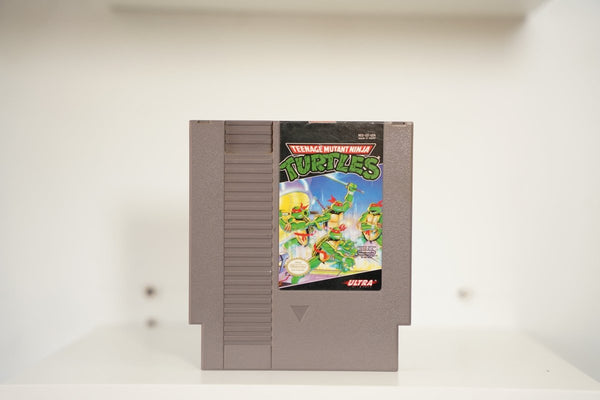
Example 8, Sega Genesis TMNT: The Hyperstone Heist. Konami beat-em-up, rectangle case, late Genesis production. Five-character product code on the back matched published Sega catalog. Label aging consistent with rectangle-era adhesive. Common chase title for Konami and TMNT collectors both.
Each of these went out the door with macro photos of the front label, back label, shell screws, and where applicable the PCB visible through the cartridge slot. The grade on the listing reflected what those photos showed, not what the title commanded on average.
When in doubt, bring it in
We are at 707 East Fremont Street, Suite 1170, ground floor of Container Park, open seven days a week. Walk in with a cart, a box, a sealed copy you bought at an estate sale, or a binder of Game Boy titles your cousin left in a closet. We will pull the loupe, the scale, and the reference console out, and we will tell you what we see, authentic, reproduction, repaired, or unsure, at no cost.
If we buy it, we buy it on the spot. If we do not buy it, you walk out knowing what you have and roughly what it is worth in the current market. Either way, the cart goes back in your bag the way it came in.
For mail-in authentication on higher-value pieces, contact us at info@keepitclassiclv.com or (702) 605-3332 first so we can stage intake.
FAQ
How do I tell if a Nintendo cartridge is a reproduction? Check four physical signals in order: PCB color through the cartridge slot, screw style on the back of the shell, cart weight against a known-good reference, and label registration under magnification. Two or more failures means reproduction. Boot the cart on real hardware and watch for blue or black flicker on the title screen.
What does "battery still saves" mean on your listings? We hardware-tested the save function within the last sixty days. The cart wrote a save, read it back, and persisted that save through a full power cycle on a real console. Battery condition language is documented in the save-battery section above.
Will SNES, N64, or GBA games from Japan work on my US console? Not without modification. Japanese SNES (Super Famicom) carts are physically a different shape and will not fit a US SNES slot. Japanese N64 carts fit physically but are region-locked at the cartridge level. Japanese GBA carts will boot on a US GBA but some titles ship with Japanese-only text. Region is listed on every PDP.
What is the difference between a first-print and a Player's Choice cartridge? First-print is the original retail label. Player's Choice (Nintendo) and Greatest Hits (later platforms) are budget reprints under a banner across the top of the label. Same game, later print run, generally lower collector value. The launch-window first print is the premium copy on chase titles.
Do you replace dead save batteries in store? Yes. Walk-in service on most SNES, N64, Genesis, Game Boy, and Game Boy Advance titles. Cost is parts plus a flat fifteen-minute labor charge. Cart usually back in your hands the same day.
How do you grade box and manual condition? Four tiers: sealed, CIB (cart plus box plus manual plus inserts), box and cart no manual, and cart only. Box structural condition (crushing, tape repair, panel splits) and manual completeness (page count, water damage, creasing) are photographed and graded on the listing.
Why is the PCB date code more reliable than the label? Labels were printed in batches and warehoused, so a label can predate the cart it ended up on by months. The PCB itself was etched at manufacture and dated within days of the cart being assembled. Visible through the cartridge slot on N64 and many SNES titles, the PCB code is the most honest dating signal a cartridge carries.
Do you authenticate cartridges I buy elsewhere? Yes, no charge for walk-in authentication on a single cart. Mail-in authentication on higher-value or larger lots, contact us first to stage intake.
Will a reproduction cart damage my console? Most will not, but some early-2010s reproductions had voltage regulation issues that stressed the cartridge slot and the console's ROM read circuitry. The risk is real but small. We do not recommend running reproductions on flagship console hardware you care about.
What else does Keep It Classic carry besides games? Vintage apparel, retro toys, VHS, jerseys, and one-of-one collectibles. The shop is curated, not bulk; everything in the case has been hand-graded by the same routine described above. See the shop hub or visit us at Container Park.