

Field Guide
How To Authenticate Vintage Jerseys: A Shop Owner's Guide
How To Authenticate Vintage Jerseys
A jersey is a small archive of manufacturing decisions. The neck tag, the stitch density, the fabric weight, the way the nameplate sits against the body cloth, every one of those choices was made for a reason, and those reasons changed year by year. Once you know what each era looked like, a jersey tells you when it was made, who licensed it, and whether the version in your hands is the real run or a later reproduction.
We hand-grade every jersey that crosses our floor at Keep It Classic. That means each piece gets read against manufacturer eras, tag iterations, stitch pattern, fabric weight, and run consistency before it goes on the rack. This guide is the version of that process we wish we had when we started. It is for collectors, for gift-buyers checking a piece before they spend, and for anyone who picked something up at an estate sale and wants to know what they actually have.
What this guide covers, in order: how the major manufacturers (Mitchell & Ness, Champion, Russell Athletic, Starter, CCM, Adidas) used different tags, fonts, and construction across the 80s, 90s, 2000s, and reissue eras; how to date a jersey by its neck tags and country-of-origin codes; the difference between stitched twill letters and screen-printed letters and why that matters more than most people think; the gap between player-issued and retail-tier construction; what the modern reproduction market gets wrong; how to read fabric era and mesh history; and a short Starter jacket sub-section that links sideways to our deeper Starter jacket authenticity guide. Then a From the Vault section pulling specific archived jerseys from our floor, and an FAQ.
This is a hand-on-fabric guide. We are not selling a database lookup. We are showing you what we look at, in what order, when a jersey lands at the counter.
Manufacturer eras
The five names that account for the overwhelming majority of authentic vintage jerseys in the US market are Mitchell & Ness, Champion, Russell Athletic, Starter, and CCM. Adidas matters for the late 2000s NHL and NBA tiers. Each had a recognizable run.
Mitchell & Ness is the throwback house. Founded in Philadelphia in 1904, they spent most of the century as a regional sporting-goods maker, then began producing licensed throwback jerseys in the 1980s and exploded into a streetwear staple in the late 1990s and early 2000s. Mitchell & Ness throwbacks of that era are heavyweight, double-needle stitched, with twill-on-twill numerals (not single-layer, but a number layered onto a backing twill of contrast color). The neck tag through that period reads Mitchell & Ness Nostalgia Co. with the year of the original season the jersey commemorates printed on a sub-tag. A real M&N from the 1999–2007 era has a hangtag that calls out the player, the year, and the season; the body cloth is dense and the jersey has weight in the hand. Reproductions made for the discount market from the 2010s onward feel light, the twill is thinner, and the contrast backing on the numerals is often missing.
Champion held the NBA on-court license from 1990 to 2002 and licensed across NCAA, NFL replicas, and broad college apparel through the same window. The Champion era you want is the 90s tag: Champion in red script with the running-figure C logo and a country-of-origin sub-tag (USA, Mexico, or Honduras most commonly, with smaller runs from Pakistan and Tunisia). The font is consistent. The body cloth on a real 90s Champion NBA jersey is a heavyweight mesh with a tight knit and the numerals are stitched twill, not heat-pressed. By the late 90s Champion ran a flag tag with the year woven in; that is your fastest dating signal on a Champion piece.
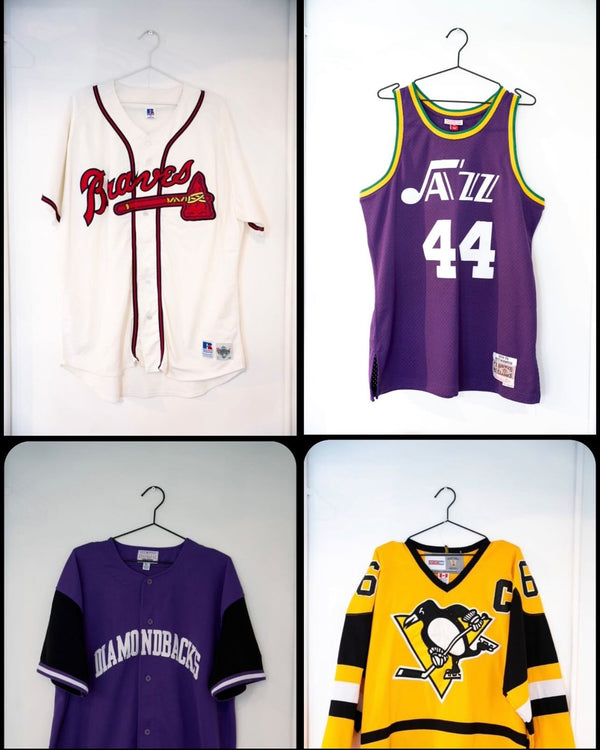
Russell Athletic is the workhorse of MLB and NFL replica licensing through the 80s and into the 90s. Russell tags from the late 80s read Russell Athletic in block with a sport-specific sub-line (MLB Authentic Diamond Collection, NFL Pro Line). Russell Diamond Collection MLB jerseys of that period are the gold standard for replica-tier baseball: heavyweight body, stitched chest letters, button placket on the older runs, and a clean dye-job that does not mottle when held to light.
Starter is the king of the 90s satin jacket and the early-to-mid 90s NBA, NFL, and NHL replica jersey. Starter neck tags went through several iterations: the early-90s Starter in arched white-on-black with the star logo, the mid-90s simpler tag with city/team callout, and the late-90s phase-out tag. Starter satin jackets and pullovers carry a distinctive heavyweight nylon-satin shell that has a particular dry hand and a specific weight at the hem.
CCM is the canonical name in hockey jerseys from the 70s through the 2000s. CCM Center Ice and CCM Maska runs are the two big sub-lines collectors look for. The Maska Air Knit fabric is the tell, a specific lofted polyester knit with a recognizable cell pattern. Modern CCM reissues are not woven the same way. Reebok absorbed CCM's NHL on-ice contract in the late 2000s and Adidas took over from Reebok in 2017, so the CCM era for NHL on-ice authentic jerseys ends cleanly at the 2007–2008 season.
Adidas matters specifically for late-2000s soccer kit, late-2010s NHL on-ice, and certain college runs. Adidas tags are dense with size codes, FIFA license stamps where applicable, and country-of-origin codes that frequently include Indonesia, Vietnam, Thailand, and Tunisia.
The fastest authentication move is to read the neck tag against the manufacturer era. If a jersey claims to be a 90s Champion piece but the neck tag is the post-2009 Hanesbrands-licensed Champion logo, the jersey is post-era. If a jersey claims to be a CCM Maska Air Knit but the fabric does not have the lofted cell pattern, the jersey is a reissue or a reproduction. The tag and the fabric have to agree.
Tag dating
A neck tag is the smallest, densest piece of evidence on a jersey, and it is the first thing we read. Four signals matter: the manufacturer logo and font, the country of origin, the size system, and the care/content sub-tag.
The manufacturer logo style anchors the era. Champion alone has at least four distinct neck-tag iterations across its NBA-license run, and the differences are visible to the eye: the 1990–1993 Champion script has a different terminal flourish than the 1996–1999 version, and both differ from the post-2002 retail tag. Cataloging neck-tag iterations is the single highest-leverage authentication skill you can build.
Country of origin is your second signal. A 90s Champion NBA jersey was overwhelmingly made in the USA, Mexico, or Honduras. A Starter satin jacket from 1992–1995 was overwhelmingly made in Korea or Taiwan. A Russell Athletic Diamond Collection MLB jersey from the late 80s was usually USA-made. A jersey claiming to be 90s era but tagged Made in China or Made in Vietnam deserves a second look, production shifted but the early 90s runs were not yet on those lines.
Size systems shifted across decades. Early 90s NBA Champion jerseys ran on the 36/40/44/48/52 chest-numeric scale. Late 90s and early 2000s shifted to S/M/L/XL with a chest-numeric sub-tag. Russell MLB Diamond Collection used the chest-numeric scale through the 90s. A jersey with an alpha size only and no chest-numeric backup is usually post-2000 retail or a reissue.
Care/content sub-tags carry an RN number (Registered Identification Number) and sometimes a CA number (Canadian equivalent). RN numbers are searchable in the FTC database and tie to the manufacturer of record at the time of production. They will not tell you the year, but they will confirm the manufacturer entity, which catches relabeled reproductions.
Stitched vs screen letters
This is the single most-asked authentication question. The short answer: through the 80s and 90s, the on-court and authentic-tier jerseys carried stitched twill letters and numerals; the replica tier mixed stitched and screen-printed depending on year and brand; and the discount/promotional tier ran screen-printed even in the authentic-era window.
Stitched twill is a separate piece of fabric (usually polyester twill) cut to letter or numeral shape and sewn onto the body cloth with a contrast thread, almost always a zig-zag stitch around the perimeter. On the higher tier you get tackle twill, which is two layered twills (a backing color and a foreground color) sewn together, giving the numeral a contrast outline that you can feel as well as see. Tackle twill is the standard for player-issued and on-court authentic in the throwback era.
Screen-printed letters sit on the surface of the body cloth as ink. They have no edge to feel. Vintage screen-printed letters from the 80s and 90s do crack and fade with time and that crackle pattern is itself an age signal, modern reproductions tend to use plastisol inks that do not crackle the same way. A screen-print on a jersey is not by itself a fake signal; what matters is whether the manufacturer and tier match the construction. A 90s Champion replica MLB jersey with screen-printed chest text is era-correct. A 90s Mitchell & Ness throwback NBA jersey with screen-printed numerals is not.
Reproductions made for the discount market often skip tackle twill entirely and run a single layer of twill or even a screen-print impersonating twill. When the numeral is single-layer twill but the era and manufacturer call for tackle twill, that is a reproduction tell.
Player-issued vs retail
Player-issued (also called pro-cut, on-court, or on-field) is the construction tier sized and built for the actual roster. Retail-tier (replica or authentic-replica) is the consumer-market construction. Both are real licensed product. They differ in fit, fabric, and finish.
Player-issued jerseys typically run longer in the body and longer in the sleeves to accommodate athlete proportions. The fabric is usually a different weight or vent pattern. The neck tag often carries an additional sub-tag indicating pro-cut or game-issued; on some runs the player number is sewn into a content tag. Player-issued NBA jerseys from the 90s are notably longer in the body than the retail equivalent.
Retail authentic is the tier just below player-issued. Same construction approach (tackle twill, heavyweight body), consumer sizing. Retail replica is the lowest tier and uses lighter fabric, often screen-printed letters, and a simpler nameplate construction.
Two practical tells: pro-cut bodies are longer than retail, often by 2 to 4 inches at the hem; and pro-cut neck tags frequently carry an additional sub-tag the retail version does not. If you are seeing a 90s Champion NBA jersey with a body longer than the retail standard and a sub-tag callout, that is a pro-cut signal worth investigating further with a manufacturer-specific reference.
Starter jackets
Starter is its own authentication conversation because the satin jacket and the pullover have construction signals that do not generalize from jersey practice. The shell weight, the snap-front hardware, the embroidered chest emblem, the lining seam pattern, and the inside neck tag iteration all matter.
Genuine 90s Starter satin jackets carry a specific nylon-satin shell with a particular dry hand and weight at the hem. Snap-front hardware is heavy metal, not stamped lightweight. Chest emblems are embroidered with dense thread count, not heat-pressed. The neck tag goes through several Starter iterations across the early, mid, and late 90s. Modern reproduction satin jackets typically run lighter shell weight, lighter snaps, and a chest emblem that is heat-applied or sublimated rather than stitched.
We have a deeper Starter-specific reference at Starter jacket authenticity covering tag iterations, snap dating, lining patterns, and the specific reproduction tells we see most often on the secondary market. Read it sideways to this guide if Starter is what you collect.
Reproduction warning signs
The reproduction market has matured. Cheap fakes are still cheap and easy to spot, but the higher-tier reproduction market now produces pieces that pass a casual look. The reliable tells:
Wrong neck tag for the claimed era. Always the first check. If the manufacturer logo style does not match the production window for the year claimed, the jersey is post-era. This catches the most reproductions.
Wrong fabric weight. Reproductions almost universally come in lighter than authentic-era construction. A 90s Champion NBA jersey should have weight in the hand. A reissue or a fake feels like a t-shirt.
Wrong stitching. Single-layer twill where tackle twill belongs, or screen-print where stitched letters belong.
Modern country of origin codes on a vintage-claimed piece. Production shifted over time. Pre-1995 production windows do not include certain origin codes that became standard in the 2000s.
Modern fiber content. A 90s jersey with a content tag listing recycled-polyester percentages is post-era. Recycled-content callouts are a 2010s and later development.
Misregistered logos and numerals. Authentic-era stitching has tight registration. Reproductions frequently have a numeral 1 to 3 mm off-center on the chest or back.
The body of the jersey can lie. The tag rarely does. When in doubt, photograph the neck tag, the size sub-tag, and the country-of-origin tag together under good light, then compare against a known-authentic reference of the same manufacturer and year.
Fabric eras
Fabric history matters because manufacturers changed materials over time and the changes are dateable. A short pass through the most relevant transitions:
Mesh. Pre-1990s mesh was a heavier knit with larger cell openings. Early 90s and mid 90s NBA Champion mesh runs slightly lighter with a tighter knit. Late 90s mesh tightens further. The Maska Air Knit polyester used by CCM through the NHL on-ice era is its own specific lofted knit and does not appear on non-hockey production.
Durene cotton. Durene is a mercerized cotton with a specific sheen used heavily on baseball jerseys through the mid-century and into the 70s. Authentic durene-era jerseys carry a distinctive cotton hand and a slight luster. Modern reproductions of mid-century baseball jerseys often skip durene for a polyester knit and the difference is visible under directed light.
Satin nameplate. Nameplate construction transitioned from sewn-on twill to sewn-on satin to direct-embroidery across different sport licenses at different times. NHL nameplates moved to a satin-and-twill hybrid in specific years. The nameplate construction has to match the year of the on-ice authentic run for a hockey jersey to authenticate.
Heavyweight body cloth. A standing rule: pre-2005 authentic-era jerseys are heavier than what the discount market produces today. Hand-feel weight is a fast-confidence signal once you have handled enough authentic pieces.
From the Vault
A handful of jerseys we have moved through the floor recently, with the macro authentication signals we read on each. These are sold pieces; what they teach is the authentication move that worked.
Starter ASU Sun Devils, full Starter mid-90s licensed run. Signal we read: Starter neck tag iteration matched the 1994–1996 production window; embroidered chest emblem with dense thread count and stitched twill numerals on the back; body cloth weight consistent with the Starter heavyweight standard for the era.
1990 UNLV Rebels Road to Denver, XL. Local provenance piece. Signal we read: era-correct screen graphic with the 1990 Final Four artwork, body cloth weight and stitch pattern at the hem consistent with early-90s licensed college apparel; collar tag dated to the production window.
Vintage Nike UNLV Rebels Red Football Jersey, XXL. Late-90s Nike collegiate authentic-tier. Signal we read: Nike collegiate neck tag iteration, tackle twill numerals on the front and back, mesh body weight consistent with late-90s Nike on-field replica.
90s Lee Sport Pittsburgh Pirates, Large. Lee Sport is the workhorse 90s MLB licensee. Signal we read: Lee Sport neck tag with MLB hologram, screen-graphic chest panel era-correct for early 90s replica tier, body cloth weight consistent with the Lee Sport standard.
90s Nutmeg Pittsburgh Steelers AFC Champions, Large. Nutmeg Mills is one of the canonical 90s NFL licensees. Signal we read: Nutmeg neck tag with the year-coded sub-tag, screen-graphic championship commemoration era-correct for the 1995 AFC champions run, body cloth weight at the Nutmeg heavyweight standard.
Vintage Colosseum Fresno State Bulldogs Football Jersey, Large. College authentic-replica tier. Signal we read: Colosseum neck tag iteration, tackle twill chest numerals, mesh body with vent panels under the sleeve consistent with mid-90s college football replica.
CCM Reebok New Jersey Devils, Medium. Transition-era hockey jersey from the CCM-to-Reebok handover window. Signal we read: dual CCM/Reebok branding consistent with the late-2000s on-ice transition years, Air Knit body fabric with the recognizable cell pattern, embroidered crest construction at the on-ice authentic standard.
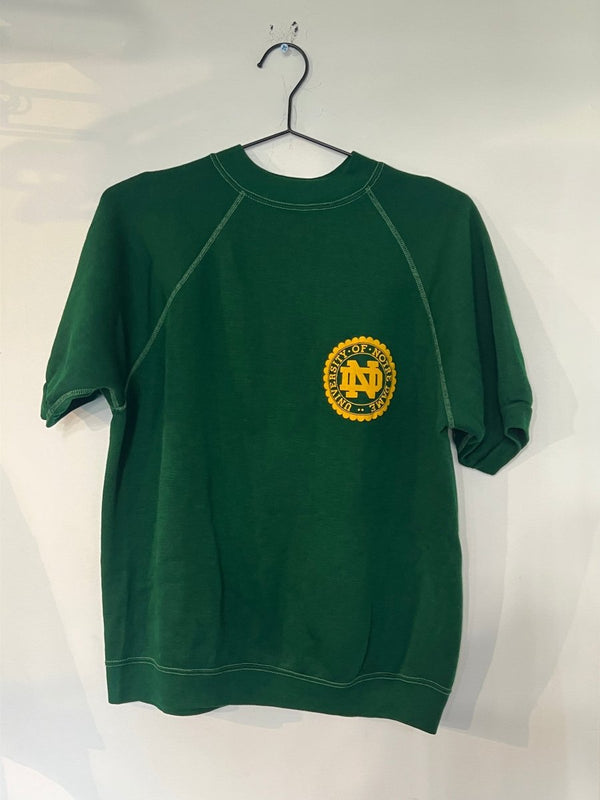
90s JanSport Notre Dame Fighting Irish Sweater, Large. JanSport ran a strong 90s NCAA collegiate apparel line that overlaps the heavier knit-sweater category. Signal we read: JanSport neck tag iteration, knit construction and weight consistent with mid-90s collegiate cold-weather, embroidered chest emblem with era-correct thread density.
Each of these read clean across the four checks: tag matches era, fabric matches manufacturer standard, construction matches tier, and the production window agrees with the licensed era.
When in doubt, bring it in
If you are within reach of Las Vegas, bring the jersey to the shop. We are at 707 East Fremont Street, Suite 1170, ground floor on the east side of Container Park, and we will read a piece against the manufacturer-era references we keep on the counter. There is no charge for an authentication read.
If you are not local, photograph the neck tag, the size sub-tag, the country-of-origin tag, the chest construction (numerals or letters), the back nameplate, and the inside hem under good light. Email the set to info@keepitclassiclv.com. We will tell you what we see and what we cannot tell from photos alone.
A jersey is worth the time to read it correctly. A real authentic-era piece holds value and will outlast a reproduction by a generation. Once you know what each manufacturer's tag, fabric, and stitch looks like, the read takes less than a minute.
FAQ
How can I tell if a Mitchell & Ness throwback is real? Read the neck tag first. The Nostalgia Co. era tags carry a specific font and a year-coded sub-tag identifying the season the jersey commemorates. Then read the body cloth weight and the numeral construction. Authentic-era M&N runs heavyweight body and tackle twill numerals with a contrast backing. Reissues and reproductions almost always come in lighter and skip the contrast backing.
How do I date a Champion NBA jersey? Champion held the NBA on-court license from 1990 to 2002. Read the Champion neck tag iteration and the country-of-origin sub-tag. By the late 90s Champion ran a year-woven flag tag that gives you a direct date. Cross-check against tackle twill construction and heavyweight mesh body.
Are Starter jackets still worth collecting? Authentic 90s Starter satin jackets and pullovers continue to hold and grow in value, particularly the team-specific runs that match active championship years. The reproduction market is wide so authentication matters more than ever. Our deeper Starter authenticity guide covers tag iterations and reproduction tells.
What is the difference between a player-issued and a retail jersey? Player-issued (pro-cut) is built for the actual roster: longer body, longer sleeves, often a different fabric weight or vent pattern, and frequently an additional sub-tag at the neck. Retail-tier is the consumer-market construction at the same authentic standard but in standard sizing. Retail-replica is the lowest tier with lighter fabric and often screen-printed letters in place of stitched twill.
How do I tell stitched twill from screen-printed letters? Run a finger across the letter. Stitched twill has a tactile edge, a stitched perimeter you can feel. Screen-print sits flat as ink on the body cloth. Tackle twill (the higher tier) has two layers and a contrast backing visible at the edge.
What is tackle twill? Tackle twill is two layers of polyester twill (a backing color and a foreground color) cut to letter or numeral shape and sewn onto the body cloth. It is the construction standard for on-court, on-field, and authentic-tier throwbacks across the major manufacturers.
Can a jersey have a real licensee tag and still be a reproduction? Yes. Relabeled reproductions exist. The defense is to cross-check tag iteration against era, fabric weight against manufacturer standard, and stitch construction against tier. A relabel will usually fail one of those three.
What is CCM Maska Air Knit? Maska Air Knit is a specific lofted polyester knit used on CCM NHL on-ice authentic jerseys. It has a recognizable cell pattern and a particular hand. Modern CCM reissues are not woven the same way. The Maska Air Knit construction is one of the highest-confidence authentication signals in hockey jerseys.
What does an RN number on a content tag tell me? The RN (Registered Identification Number) ties to the manufacturer of record in the FTC database. It does not give you a year, but it confirms the manufacturer entity, which catches relabeled reproductions where the neck tag and the content tag manufacturer entity disagree.
Where do I bring a jersey for in-person authentication? Keep It Classic at 707 East Fremont Street, Suite 1170, Las Vegas, Nevada 89101, ground floor, east side of Container Park. We will read a piece across manufacturer-era references at the counter. No charge.